Wednesday, December 13, 2017

Snow Inspires Poetry and Awe


One of the best-known poems about winter is Robert Frost’s “Stopping by Woods on a Snowy Evening.” Frost was born in California but spent most of his life in New England, so he knew about snowy winters. According to Wikipedia (citing The Robert Frost Encyclopedia for reference), however, the poem actually came to him on a summer morning as he viewed the sunrise. Maybe he made the connection because sunrises and unbroken snow are both among nature’s most inspiring scenes.

But duty calls, and the narrator of this poem doesn’t have time to stop and enjoy the moment. Here are the words.

Stopping by Woods on a Snowy Evening

Whose woods these are I think I know.
His house is in the village, though;
He will not see me stopping here
To watch his woods fill up with snow.


My little horse must think it queer
To stop without a farmhouse near
Between the woods and frozen lake
The darkest evening of the year.


He gives his harness bells a shake
To ask if there is some mistake.
The only other sound’s the sweep
Of easy wind and downy flake.


The woods are lovely, dark and deep,
But I have promises to keep,
And miles to go before I sleep,
And miles to go before I sleep.


May you find the time to stop and enjoy the beauty of winter and maybe even write a poem of your own.

­­­__________

The picture at the head of this post is a Currier and Ives lithograph titled “Snowed Up. Ruffed Grouse in Winter.” It was published around 1867 and is in the public domain because of its age.

Wednesday, December 6, 2017

Jingle Those Bells


Winter temperatures have arrived, and the snow won’t be far behind. As we get busy preparing for the upcoming holidays, it’s hard to find time to create scholarly blog posts. So we are going to take a more light-hearted approach and look at “Jingle Bells” this week. After all, isn’t it time to recognize that song lyricists are writers, too?

Most of us think of “Jingle Bells” as a Christmas song, but it doesn’t mention Christmas or any other holiday, making it more appropriately classified as a winter song. The music and lyrics were both written by James Lord Pierpont. The song was first published in 1857 under the title “One Horse Open Sleigh” and was reissued two years later under the current title. It was not a hit either time.

It’s unclear exactly when and where Pierpont wrote the song. He grew up in New England and must have been remembering winters there, but he may have written it after moving to Georgia. In fact, both Massachusetts and Georgia appear to claim the honor.

The song has four verses, and some are more familiar than others. Here is the entire text using the original words (according to that fount of all knowledge, Wikipedia).

Dashing through the snow,
In a one horse open sleigh,
O’re the fields we go,
Laughing all the way;
Bells on bob tail ring,
Making spirits bright,
Oh what sport to ride and sing
A sleighing song tonight.


Jingle bells, jingle bells,
Jingle all the way.
Oh! what joy it is to ride
In a one horse open sleigh. (REPEAT)


A day or two ago
I thought I’d take a ride
And soon, Miss Fanny Bright
Was seated by my side,
The horse was lean and lank
Misfortune seemed his lot
He got into a drifted bank
And we, we got upsot.


CHORUS


A day or two ago,
The story I must tell
I went out on the snow,
And on my back I fell;
A gent was riding by
In a one-horse open sleigh,
He laughed as there I sprawling lie,
But quickly drove away.


CHORUS


Now the ground is white
Go it while you’re young,
Take the girls tonight
And sing this sleighing song;
Just get a bobtailed bay
Two forty as his speed
Hitch him to an open sleigh
And crack! you’ll take the lead.


CHORUS


Have fun with your own winter pursuits.

_______

The picture at the head of this post is a Currier and Ives print titled “The Road – Winter.” The original was drawn on stone by Otto Knirsch no later than 1853 and supposedly shows Nathanial Currier and his wife in their favorite sleigh. Unfortunately, this picture has a two-horse open sleigh rather than a one-horse open sleigh. However, you can see the jingle bells around the white horse’s belly.

The picture and the lyrics to “Jingle Bells” are both in the public domain because of their age.

Wednesday, November 29, 2017

An IWC Thank You


Last Thursday most of us felt thankful for family, friends, homes, food, jobs, and other blessings that we have experienced over the past year. But IWC has also been blessed, and we want to take this opportunity to remember and give thanks for those blessings. We won’t mention any names, but you know who you are. Here is a partial list:

  • IWC’s officers, directors, and other volunteers who keep IWC operating;
  • Donors who contributed to the general fund, the conference, and conference scholarships, including those who donated items for the silent auction;
  • Members of the 2017 Steel Pen Conference Committee for all their work planning and running the conference;
  • Conference speakers, panelists, and presenters for providing great content;
  • Conference attendees, without whom there would be no conference;
  • The many individuals who contributed to the blog;
  • And, of course, our faithful members.

Thank you.

Wednesday, November 22, 2017

Write Thanksgiving Right

by
Kathryn Page Camp


It’s worth reminding ourselves how important it is to get the details right when writing about historical events. So this Thanksgiving week, I am reprinting parts of my November 26, 2014 IWC blog post titled “The Rest of the Thanksgiving Story.” Since I am only using parts of it, I made a few modifications to make the post flow more smoothly.
* * * * *
I wanted to add a picture of the first Thanksgiving to this post. Unfortunately, the only ones I found that were clearly in the public domain were also historically inaccurate. The photo at the head of this post is a good example. The clothing and feathers are all wrong, and the position of the two groups, with the members of the Wampanoag nation sitting on the ground and the Pilgrims standing, implies that the Pilgrims were the dominant race. Since a white woman is handing out the food, the picture could also imply that the Pilgrims provided the feast and the Native Americans were simply recipients.
As writers, we should be careful not to make the same mistakes.
When I think of the first Thanksgiving, I think of friendly Native Americans bringing their knowledge and skills and provisions to feed the starving Pilgrims. Without that help, the Pilgrims would have perished.
I’ve read comments on the Internet complaining that people today think the Pilgrims and the Native Americans merely shared a meal together, or even that the Pilgrims were the benefactors rather than the beneficiaries. I can’t say whether those complaints are valid, but it hasn’t been my experience. I learned at school and at home that Squanto and his tribe taught the Pilgrims how to survive, and my children learned the same lesson.
That’s one of the reasons I like Thanksgiving. It’s the one time of year when we remember the Native American participants as the generous people they were. That’s a lot better than the frequent stereotype of half-dressed warriors burning homes and scalping “innocent” white settlers.
Those of us with European ancestry have many reasons to be grateful to the Native Americans.
So when you write about the first Thanksgiving, make sure you get it right.
__________
The picture at the head of this post is by Jean Leon Gerome Ferris and was painted sometime around 1912-1915. It is in the public domain in the United States because of its age.
__________
Kathryn Page Camp is a licensed attorney and full-time writer who writes adult non-fiction as Kathryn Page Camp and middle-grade fiction as Kaye Page. Writers in Wonderland: Keeping Your Words Legal was a Kirkus’ Indie Books of the Month Selection for April 2014, and her first middle-grade historical novel, Desert Jewels, was released in August 2017. You can learn more about Kathryn at www.kathrynpagecamp.com.

Wednesday, November 15, 2017

Save the Date


Save that date for the Fifth Steel Pen Creative Writer’s Conference. The conference will have a Halloween theme, but the sessions will cover all genre and the only horror will be your own when you discover how much you don’t know. Or, worse, when you realize you’ve missed the registration cutoff date.

Next year’s keynote speaker will be Michael Poore. He is the author of the novels Reincarnation Blues (Del Rey, 2017) and Up Jumps the Devil (Ecco, 2012). His short work has appeared in Agni, Southern Review, Fiction, and Glimmer Train, and in anthologies, including The Year’s Best Science Fiction and The Best American Nonrequired Reading 2012.

Mike has his own brand of humor, and his books fit well with a Halloween theme. If you want to find out how, you’ll have to come to the conference, read his novels for yourself, or both.

The 2018 venue is the same as it was this year, and it was rated highly by all who attended. So join us at the Fair Oaks Farms Conference Center just off I-65 near Rensselaer, Indiana.

The call for proposals will be sent out at the beginning of the year, and registration will open in late spring or early summer. So keep your eye out for those announcements.

We hope to see you on October 27, 2018.

Wednesday, November 8, 2017

Still Excited about Steel Pen

by
Emily Baginski


On October 28, I attended the Steel Pen Conference. I was able to learn more than I expected!
The keynote speaker, Catherine Lanigan, was so amazing to listen to. Her story was motivational and inspiring to continue going down the path of becoming a published author. I even was able to have her sign my copy of one of her books!
The first breakout session I attended was about the do’s and don’ts when it comes to designing a cover for your book. Not only did I learn how to create a successful cover, I was given sites to visit that would be helpful and make the process a bit easier. In another workshop, I learned that poems and even songs have a deeper meaning. We evaluated a song and learned a deeper meaning with it. Now here I am, listening to songs, looking up representations and definitions to learn the “hidden” message/meaning.
With all of the learning side, I also was able to connect with many talented people! Familiar faces appeared at tables and being able to catch up with them was great, especially at a place where we share a common interest. Since the majority of people were older than me, I was able to ask, learn, and gain guidance on what I should and shouldn’t do in college. Next year’s conference was announced and knowing how much I learned this year, I am excited to see what next year brings.

Wednesday, November 1, 2017

We Nailed It!

 
We aren’t supposed to brag about our own conference, so we will let the numbers do it for us. Of the 70 people who attended the Steel Pen Creative Writers’ Conference on Saturday, 24 filled out the general evaluation. Of those 24, all said their likelihood of attending again was either good or excellent, with the excellents leading 17 to 7. Here are some of the written comments:

·       Great price, great presentations. Loved it!

·       It was great! Lots of work and truly appreciated.

·       Thank you for the high level of organization.

As with anything, there are opportunities for improvement, and we appreciate those comments, as well. The biggest problem was that one of the rooms was too small, and we already have some ideas on how to resolve that issue next year.

The facility at Fair Oaks Farms also received rave reviews. That’s good, since the Fifth Annual Steel Pen Creative Writer’s Conference will be held on October 27, 2018 at the same place. We will provide more information about next year’s conference in the November 15 blog post.

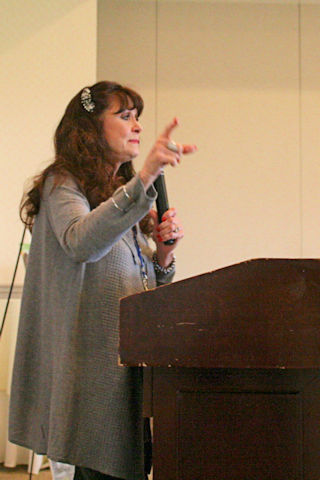
But back to this year. The highlight was the keynote speech by Catherine Lanigan, who provided inspiration to keep writing even when we’ve been told we aren’t good enough. She also presented a session on writing romance and gave tips for navigating the business side of the writing profession no matter what your genre.


As already mentioned, one of the three rooms was too small. It was supposed to hold up to 24 people, which might have worked if the Committee members had been good judges of which topics would capture the smallest audiences. For those sessions that met in the Boardroom, the classes were cramped but also intimate, as you can see from this picture of the novel-in-stories workshop presented by Melissa Fraterrigo.


Finally, the networking was wonderful, as was the food. The last photo shows the appetizers available during the cocktail hour.


Tune in next week for a personal testimony about the conference.